> ## Documentation Index
> Fetch the complete documentation index at: https://docs.debridge.com/llms.txt
> Use this file to discover all available pages before exploring further.
# Protocol Overview
> Protocol Overview: Background, Protocol Structure, and Off-chain validation.
deBridge Messaging Protocol (DMP) is the underlying cross-chain messaging protocol that powers all deBridge products, including
the deBridge Liquidity Network (DLN). DMP enables arbitrary data transfer, cross-chain execution and authenticated messages,
allowing developers to build complex cross-chain applications beyond just value transfer.
If you're looking to build cross-chain swaps, onboarding flows, or multi-step DeFi actions, you likely want to use the
[deBridge Liquidity Network](/dln-details/overview/introduction).
# Background
For a long time, bridges were viewed only as value transfer protocols and custodians responsible for locking assets on the source
chain and issuing wrapped representations of the assets on the destination chain.
The deBridge protocol drastically expands the concept of traditional bridges by introducing generic cross-chain message transfers.
Now developers and builders can interconnect any smart contracts across different blockchains to perform transfers of data and
transaction calls (messages that contain instructions to be executed, or CALLDATA) together with the value transfer in the same
transaction.
This opens up endless opportunities to build complex cross-chain interactions, such as multi-chain applications, next-layer
protocols, automated cross-chain arbitraging services, object or NFT bridges, and more!
As a generic messaging protocol and a cross-chain interoperability infrastructure, deBridge can be used to build any arbitrary
cross-chain applications (deApps). Notable solutions built on top of deBridge are:
* [deBridge Liquidity Network](https://app.debridge.com/) (DLN) — a high-performance cross-chain value transfer infrastructure
built on deBridge with 0-TVL design (no liquidity pools).
* [dePort](https://app.debridge.com/deport) — a native bridge for assets that allows protocols to bridge tokens and create utility
for their synthetic representation (deTokens) in other chains.
Your application can be the next one and this documentation and tutorials will help to dive into the protocol infrastructure and
elaborate on questions you might face while building your integration with deBridge.
# Protocol Structure
The protocol consists of 2 key layers:
* Protocol layer — on-chain smart contracts deployed in every blockchain supported by deBridge
* Infrastructure layer — off-chain validation nodes operated by validators who are elected by the deBridge governance
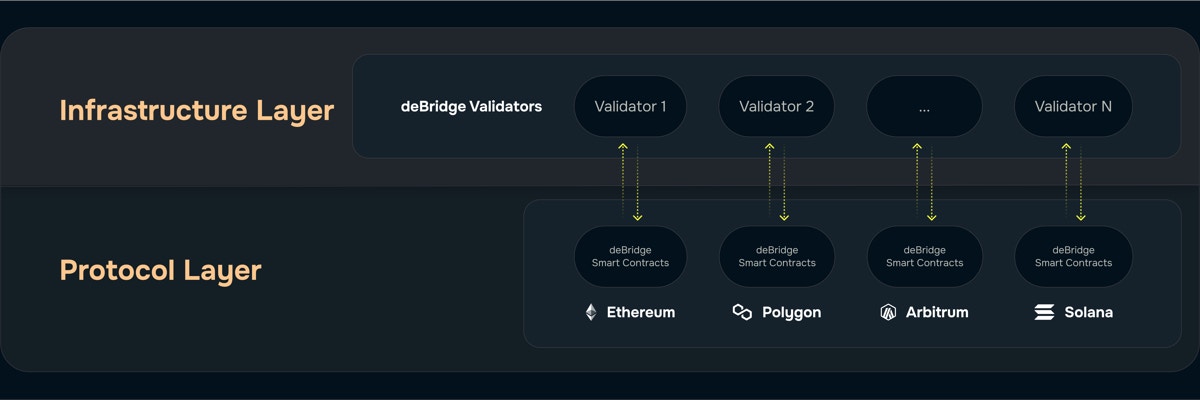 *The protocol layer* is a set of on-chain smart contracts used for asset management, routing of cross-chain transactions,
cross-validation of validators' signatures, and reaching consensus among validators as the transaction is treated as valid only if
the minimum required threshold of validators' signatures is achieved. The governance manages the parameters of the smart
contracts, such as fees, supported chains, the whitelist of elected validators, validators payout ratio, and more.
The infrastructure layer is represented by a set of reputable validators who operate a deBridge node alongside full nodes of every
blockchain supported by the protocol.
# Off-chain validation
For all bridging protocols, it’s important to have a chain-agnostic design and make the protocol operation fully independent of
the uptime of all supported blockchains. In case of downtime in any underlying blockchains, the protocol should keep processing
the transactions for all other chains.
deBridge has taken a unique approach with an off-chain transaction validation mechanic where validators don’t need to broadcast
any transactions and bear gas costs. Every cross-chain transaction initiated through the deBridge smart contract is assigned a
unique hash (Submission Id). deBridge validators are tracking all transactions that pass through the smart contract of the
protocol and soon as the transaction achieves its finality, each validator is obliged to sign the Submission by its private key.
The resulting signature is saved into Arweave, a decentralized data availability layer. Any arbitrary user or keeper can collect
validator signatures from Arweave and pass them to the DebridgeGate smart contract in the target chain alongside all transaction
parameters. Based on the passed set of parameters, the deBridge smart contract will restore a unique hash of the transaction and
cross-validate its signatures from all designated validators. In case the minimum required number of signatures is valid, the
DebridgeGate smart contract delivers the message on the destination chain by executing its' call data.
With this design, even in the eventuality that some blockchains experience downtime, deBridge will still remain fully functional
and all transactions going to the paused chain will be processed as soon as it resumes operation.
# Transaction Finality Requirements
Due to the probabilistic finality model of most blockchains, before the message is validated by the deBridge infrastructure,
validators wait for the required number of block confirmations before signing its Submission Id. The number of required block
confirmations is based on the social consensus of transaction finality in each supported blockchain.
# Delegated Staking and Slashing
Validators play a crucial role in interoperability protocols since in addition to being infrastructure providers, they also secure
the protocol by validating all cross-chain transactions passing through the protocol. Validators work for and are elected by the
governance and should bear financial responsibility for the service they provide, assured through the risk of being slashed in
case of validating a non-existent transaction or failing to maintain infrastructure uptime. Anyone can help to secure the protocol
by becoming a delegator and staking assets (e.g. ETH, USDC) for validators’ collateral. Both validators and their delegators
receive part of the protocol fees as an economic incentive for helping to secure the protocol and maintain its infrastructure.
# How it works
deBridge is DeFi's internet of liquidity — a foundational layer that enables users and protocols to transport any arbitrary
messages or CALLDATA across different chains enabling the ability to create any cross-chain solutions, such as deSwap — value
transferring protocol built on top of deBridge.
*The protocol layer* is a set of on-chain smart contracts used for asset management, routing of cross-chain transactions,
cross-validation of validators' signatures, and reaching consensus among validators as the transaction is treated as valid only if
the minimum required threshold of validators' signatures is achieved. The governance manages the parameters of the smart
contracts, such as fees, supported chains, the whitelist of elected validators, validators payout ratio, and more.
The infrastructure layer is represented by a set of reputable validators who operate a deBridge node alongside full nodes of every
blockchain supported by the protocol.
# Off-chain validation
For all bridging protocols, it’s important to have a chain-agnostic design and make the protocol operation fully independent of
the uptime of all supported blockchains. In case of downtime in any underlying blockchains, the protocol should keep processing
the transactions for all other chains.
deBridge has taken a unique approach with an off-chain transaction validation mechanic where validators don’t need to broadcast
any transactions and bear gas costs. Every cross-chain transaction initiated through the deBridge smart contract is assigned a
unique hash (Submission Id). deBridge validators are tracking all transactions that pass through the smart contract of the
protocol and soon as the transaction achieves its finality, each validator is obliged to sign the Submission by its private key.
The resulting signature is saved into Arweave, a decentralized data availability layer. Any arbitrary user or keeper can collect
validator signatures from Arweave and pass them to the DebridgeGate smart contract in the target chain alongside all transaction
parameters. Based on the passed set of parameters, the deBridge smart contract will restore a unique hash of the transaction and
cross-validate its signatures from all designated validators. In case the minimum required number of signatures is valid, the
DebridgeGate smart contract delivers the message on the destination chain by executing its' call data.
With this design, even in the eventuality that some blockchains experience downtime, deBridge will still remain fully functional
and all transactions going to the paused chain will be processed as soon as it resumes operation.
# Transaction Finality Requirements
Due to the probabilistic finality model of most blockchains, before the message is validated by the deBridge infrastructure,
validators wait for the required number of block confirmations before signing its Submission Id. The number of required block
confirmations is based on the social consensus of transaction finality in each supported blockchain.
# Delegated Staking and Slashing
Validators play a crucial role in interoperability protocols since in addition to being infrastructure providers, they also secure
the protocol by validating all cross-chain transactions passing through the protocol. Validators work for and are elected by the
governance and should bear financial responsibility for the service they provide, assured through the risk of being slashed in
case of validating a non-existent transaction or failing to maintain infrastructure uptime. Anyone can help to secure the protocol
by becoming a delegator and staking assets (e.g. ETH, USDC) for validators’ collateral. Both validators and their delegators
receive part of the protocol fees as an economic incentive for helping to secure the protocol and maintain its infrastructure.
# How it works
deBridge is DeFi's internet of liquidity — a foundational layer that enables users and protocols to transport any arbitrary
messages or CALLDATA across different chains enabling the ability to create any cross-chain solutions, such as deSwap — value
transferring protocol built on top of deBridge.
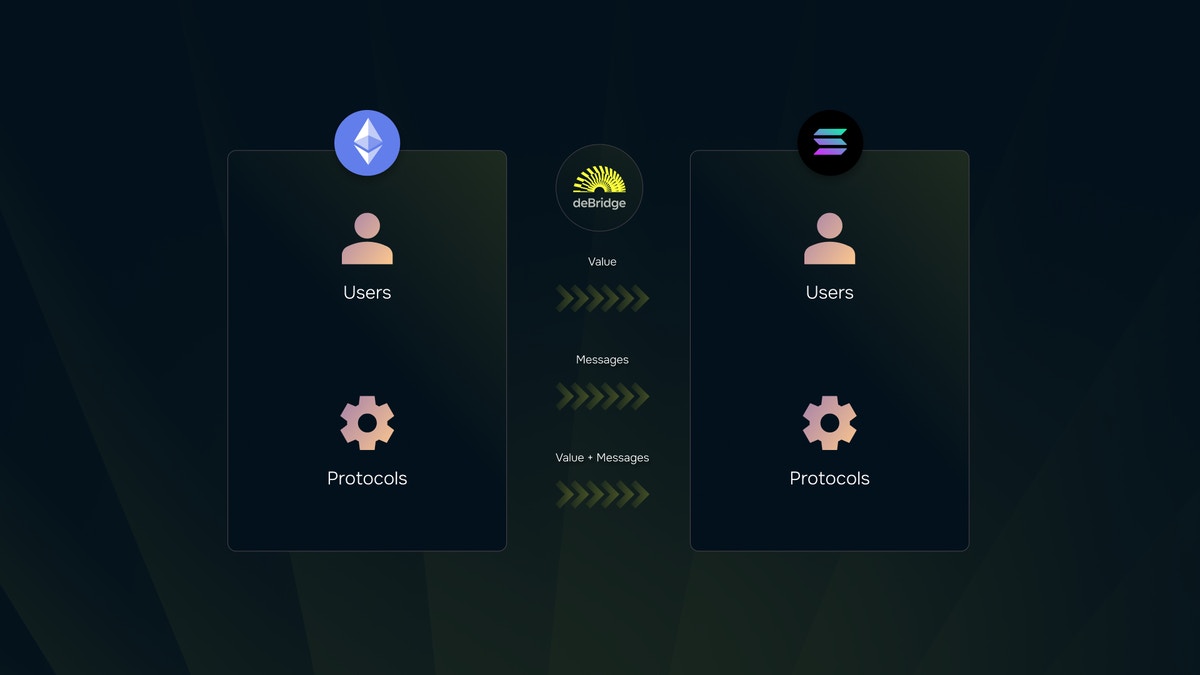 The ability to pass arbitrary data opens up opportunities for true cross-chain composability of smart contracts and protocols that
can now interact with each other despite they live in different blockchain ecosystems. An example would be an algorithmic
stablecoin protocol on Ethereum that opens positions in perpetual markets protocol on Solana or Arbitrum in order to maintain the
peg of its asset.
deBridge allows the building of a new generation of cross-chain protocols and applications that haven’t been possible in the past.
Some of the use cases are:
* Cross-chain swaps
* Multi-chain governance
* Cross-chain lending
* Cross-chain yield farming
For more details, check out the dedicated deBridge Messaging Protocol section.
The ability to pass arbitrary data opens up opportunities for true cross-chain composability of smart contracts and protocols that
can now interact with each other despite they live in different blockchain ecosystems. An example would be an algorithmic
stablecoin protocol on Ethereum that opens positions in perpetual markets protocol on Solana or Arbitrum in order to maintain the
peg of its asset.
deBridge allows the building of a new generation of cross-chain protocols and applications that haven’t been possible in the past.
Some of the use cases are:
* Cross-chain swaps
* Multi-chain governance
* Cross-chain lending
* Cross-chain yield farming
For more details, check out the dedicated deBridge Messaging Protocol section.