> ## Documentation Index
> Fetch the complete documentation index at: https://docs.debridge.com/llms.txt
> Use this file to discover all available pages before exploring further.
# Cross-Chain Call Lifecycle
> Lifecycle of a cross-chain call from submission to claim.
Blockchains by their nature are siloed environments that cannot directly communicate with each other. That is why any messaging protocol is a complex
set of components, making any cross-chain transaction a multistage process, so just initiating a cross-chain transaction typically is not enough. It
is important to understand how the deBridge infrastructure works so you can manage your submissions (either manually or even automatically)
consciously and confidently.
The following scheme visualizes a normal cycle of a typical cross-chain call, as it may look for the [conceptual cross-chain
dApp](https://github.com/debridge-finance/debridge-cross-chain-dapp-example) where Incrementor is used as an example of the smart contract that sends
a cross-chain message:
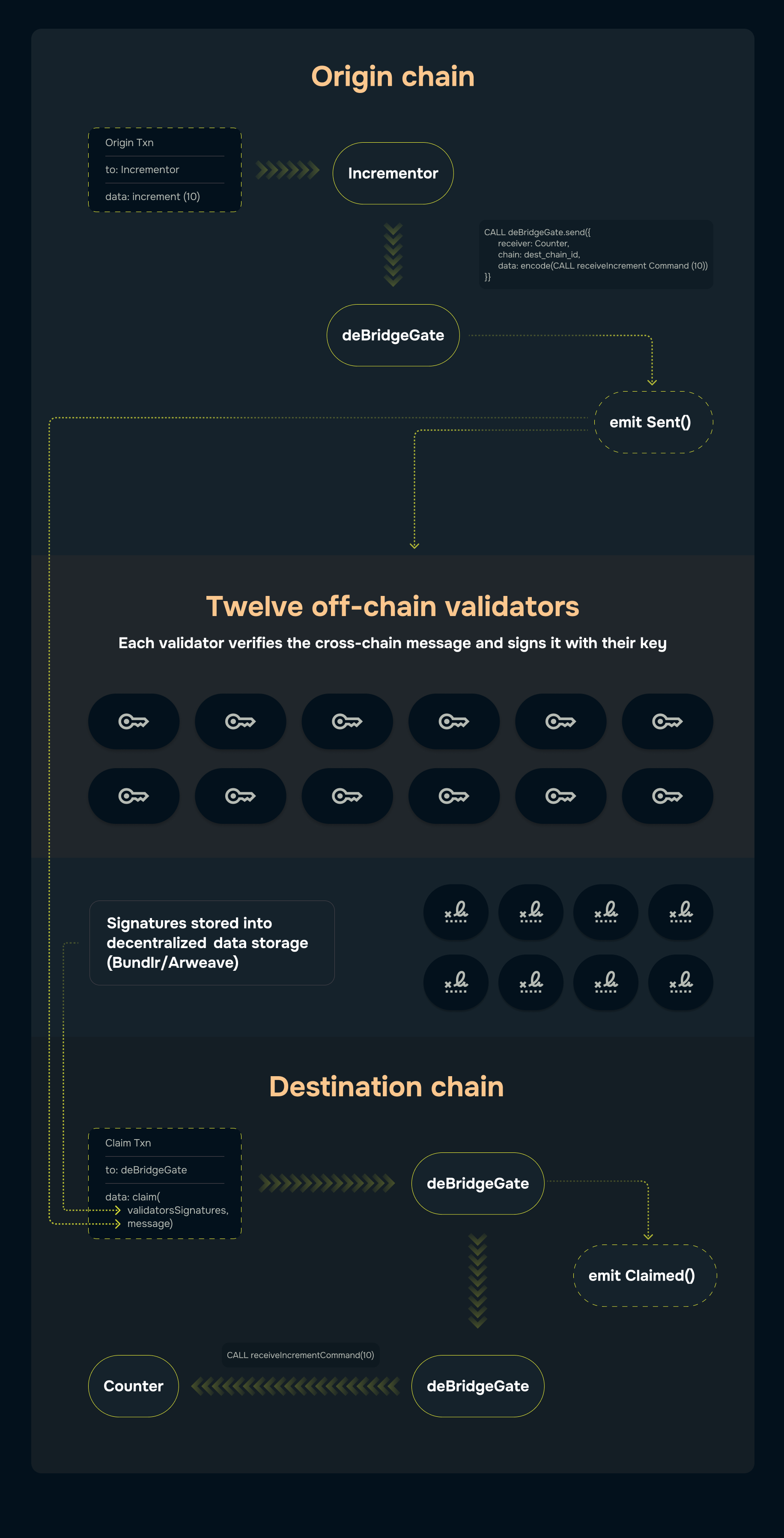 When a call to the `deBridgeGate.send()` method is made on the origin (source) chain, the gate contract validates the input (its args and the
`autoParams` struct), and if everything is correct (the data is unambiguous, the input asset covers the fees, etc), a special `Sent` event is emitted.
This event exposes the following details of the submission:
* `submissionId`, the identifier of the cross-chain transaction you've initiated;
* `debridgeId`, the cross-chain identifier of the input asset, needed to correctly handle tokens across supported chains;
* `args` and the `autoParams` structure that contains information about the passed message.
You are advised to monitor this event to ensure your submission has been accepted and the cross-chain transaction has been initiated.
[deBridge validators](https://app.debridge.com/validation-progress) listen for these events emitted by the deBridgeGate smart contract deployed on
all supported chains, and for each tracked event validator performs the following set of actions:
* waits a specific amount of block confirmations (12 block confirmations for supported EVM chains, and 256 block confirmations for the Polygon
network) to ensure the finality of the transaction where the event has been emitted,
* validates the args and the structure,
* if the data is correct, sign the message with its own private key, and publish the signature to Arweave.
Note: Validators' financial responsibility to be enabled through [Slashing and Delegated Staking](/dmp-details/dmp/slashing-and-delegated-staking).
After the minimum required number of validators have signed the message (eight at the time of writing, ⅔ of all possible signatures), the submission
is confirmed and may be claimed on the destination chain.
You can access the actual minimum required number of signatures by querying the `minConfirmations` property of the `signatureVerifier` contract:
```solidity theme={null}
ISignatureVerifier(IDebridgeGate(deBridgeGate).signatureVerifier).minConfirmations
```
To claim the submission, a claiming transaction should be crafted, signed, and sent to the blockchain. Such transaction must contain a call to the
`claim()` method of the `deBridgeGate` contract with the submission's data (taken from the `Sent` event) and minimal required number of validators'
signatures provided as its args.
Worth mentioning that such transactions may be signed and sent by anyone who is willing to pay the gas for its' execution on the destination chain.
There is no security implication because during the claiming phase the `deBridgeGate` contract first checks the integrity of the message (the args and
the `autoParams` struct that was initially passed to the `send()` method on the origin chain) by verifying each validator's signature against their public
key, and then executing the instructions this message contains.
There are three ways to trigger a claiming transaction:
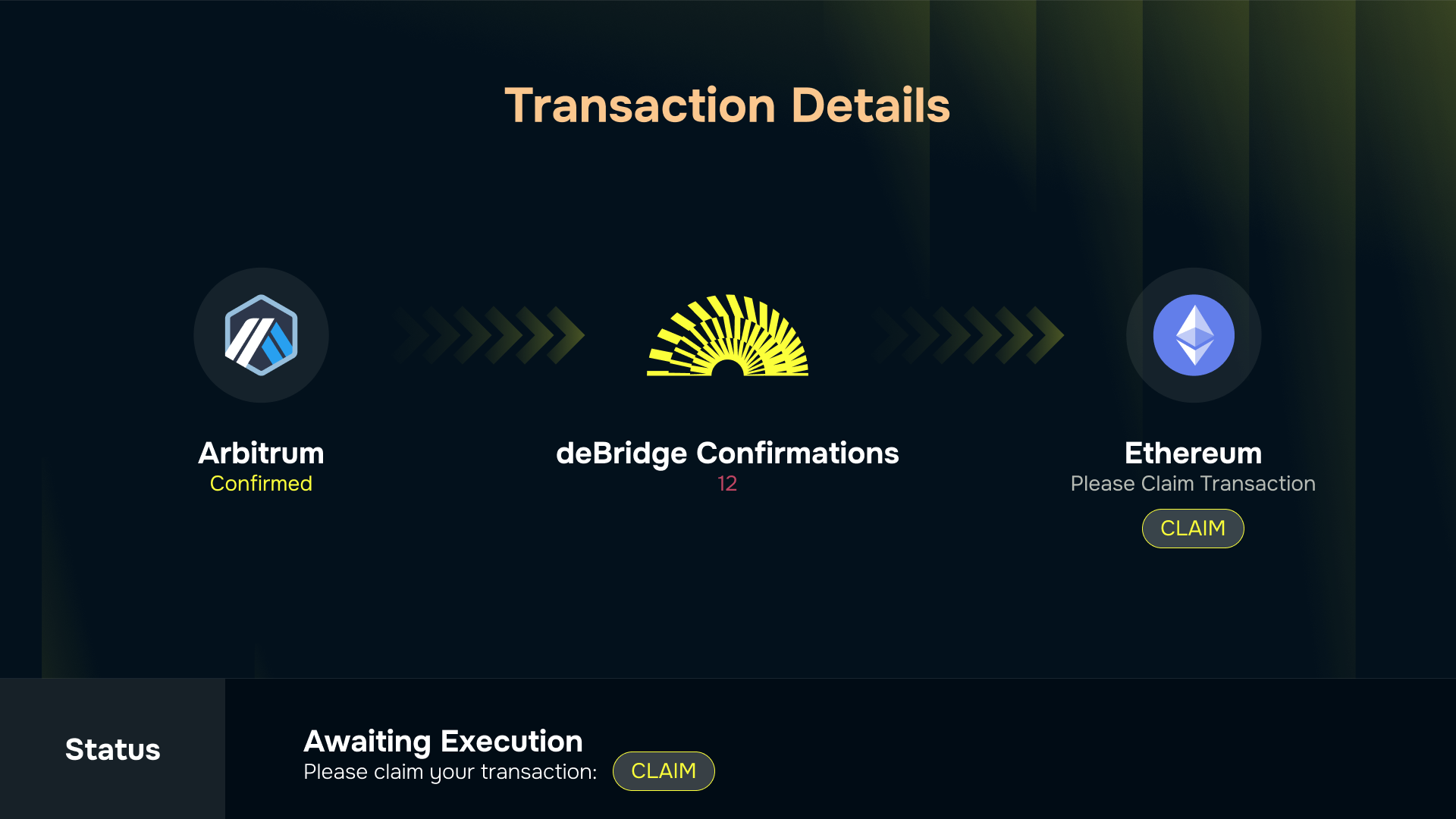
* manually, by visiting [deExplorer](https://explorer.debridge.com/), where you can find your cross-chain transaction by its `submissionId` or even
by the hash of the origin transaction, then sign the prepared claiming transaction using the browser wallet (MetaMask, etc);
When a call to the `deBridgeGate.send()` method is made on the origin (source) chain, the gate contract validates the input (its args and the
`autoParams` struct), and if everything is correct (the data is unambiguous, the input asset covers the fees, etc), a special `Sent` event is emitted.
This event exposes the following details of the submission:
* `submissionId`, the identifier of the cross-chain transaction you've initiated;
* `debridgeId`, the cross-chain identifier of the input asset, needed to correctly handle tokens across supported chains;
* `args` and the `autoParams` structure that contains information about the passed message.
You are advised to monitor this event to ensure your submission has been accepted and the cross-chain transaction has been initiated.
[deBridge validators](https://app.debridge.com/validation-progress) listen for these events emitted by the deBridgeGate smart contract deployed on
all supported chains, and for each tracked event validator performs the following set of actions:
* waits a specific amount of block confirmations (12 block confirmations for supported EVM chains, and 256 block confirmations for the Polygon
network) to ensure the finality of the transaction where the event has been emitted,
* validates the args and the structure,
* if the data is correct, sign the message with its own private key, and publish the signature to Arweave.
Note: Validators' financial responsibility to be enabled through [Slashing and Delegated Staking](/dmp-details/dmp/slashing-and-delegated-staking).
After the minimum required number of validators have signed the message (eight at the time of writing, ⅔ of all possible signatures), the submission
is confirmed and may be claimed on the destination chain.
You can access the actual minimum required number of signatures by querying the `minConfirmations` property of the `signatureVerifier` contract:
```solidity theme={null}
ISignatureVerifier(IDebridgeGate(deBridgeGate).signatureVerifier).minConfirmations
```
To claim the submission, a claiming transaction should be crafted, signed, and sent to the blockchain. Such transaction must contain a call to the
`claim()` method of the `deBridgeGate` contract with the submission's data (taken from the `Sent` event) and minimal required number of validators'
signatures provided as its args.
Worth mentioning that such transactions may be signed and sent by anyone who is willing to pay the gas for its' execution on the destination chain.
There is no security implication because during the claiming phase the `deBridgeGate` contract first checks the integrity of the message (the args and
the `autoParams` struct that was initially passed to the `send()` method on the origin chain) by verifying each validator's signature against their public
key, and then executing the instructions this message contains.
There are three ways to trigger a claiming transaction:
* manually, by visiting [deExplorer](https://explorer.debridge.com/), where you can find your cross-chain transaction by its `submissionId` or even
by the hash of the origin transaction, then sign the prepared claiming transaction using the browser wallet (MetaMask, etc);
 * automatically, by specifying sufficient `executionFee` property within your submission: in this case, Claimers will execute the transaction and
deliver the message in case the supplied on the source chain `executionFee` (included gas) covers their gas on the destination chain.
Claimer may wait to deliver the message (submission) in case of gas price spikes (if the value of the included gas becomes less than the cost of
execution). In this case, you should trigger a claiming txn on your own, either manually or programmatically, and you'll receive back the supplied
included gas (instead of the Claimer service);
* programmatically, by constructing a claiming txn with a little help of [deSDK](https://github.com/debridge-finance/desdk) (this is what Claimer
service actually does automatically).
After the claiming txn is sent and included in the blockchain, and the `deBridgeGate.claim()` call succeeds, a special `Claimed` event is emitted by the
`deBridgeGate` contract signaling the successful completion of the cross-chain transaction. Voila!
* automatically, by specifying sufficient `executionFee` property within your submission: in this case, Claimers will execute the transaction and
deliver the message in case the supplied on the source chain `executionFee` (included gas) covers their gas on the destination chain.
Claimer may wait to deliver the message (submission) in case of gas price spikes (if the value of the included gas becomes less than the cost of
execution). In this case, you should trigger a claiming txn on your own, either manually or programmatically, and you'll receive back the supplied
included gas (instead of the Claimer service);
* programmatically, by constructing a claiming txn with a little help of [deSDK](https://github.com/debridge-finance/desdk) (this is what Claimer
service actually does automatically).
After the claiming txn is sent and included in the blockchain, and the `deBridgeGate.claim()` call succeeds, a special `Claimed` event is emitted by the
`deBridgeGate` contract signaling the successful completion of the cross-chain transaction. Voila!